THE HISTORY
A world-class production center

Montelupo Fiorentino is located on the outskirts of Florence, in a lush area, bordered by two waterways. Over the centuries, the town’s history has been closely linked to ceramics, especially between 1400 and 1530, when Montelupo was the center of majolica production for the city of Florence.
The MONTELUPO CERAMIC ROAD was created to promote and enhance this history and much more. The Montelupo ceramic road is a territorial system that also extends to some parts of neighboring municipalities (Capraia e Limite, Lastra a Signa, and Montespertoli). It is a system that combines ceramic art with tourist hospitality, cultural aspects with a typically Tuscan landscape, the promotion of local products with a rich calendar of events. An ideal itinerary that connects the Montelupo Ceramic Museum, the ceramic manufacturing companies, the Ceramic School, and associations working to keep this ancient craft alive…
A history spanning eight centuries
The local activity started in the 13th century and focused mainly on majolica (glazed ceramics), until it found two fundamental opportunities for development with the conquest of Pisa (1406), which opened the sea access to Florentine goods, and the simultaneous competition with Spanish ceramics—produced particularly in the Montelupo area—which forced Montelupo to improve the quality of its production.
The productive and technological development attracted important commissions during the 15th century; many noble Florentine families (Medici, Strozzi, Machiavelli, Canigiani, Frescobaldi, Pucci, etc.) directed their orders to local kilns or received Montelupo majolica as gifts.
In Montelupo, around the 1480s, Renaissance decorations were developed and elaborated.
Montelupo majolica then reached its peak commercial expansion, spreading widely in the Mediterranean basin (Greece, Egypt, Morocco, Spain, and France), along the Atlantic trade routes (southern England, Holland), and in overseas countries (Montelupo ceramics have been found in Cuba and Virginia).
In the 1600s, a slow decline in ceramic production began, and it would be resumed only in 1911.
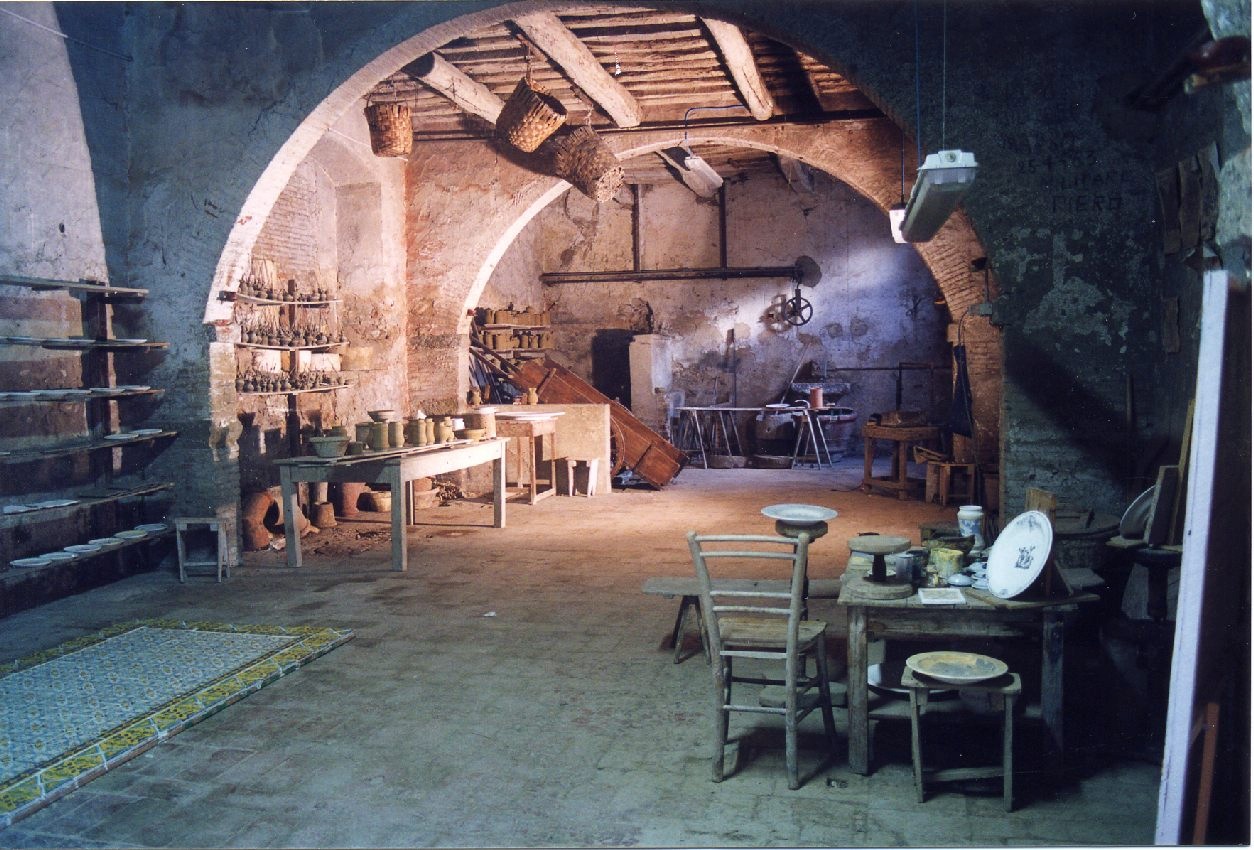
Even today, ceramics are a distinctive feature of Montelupo, an element that characterizes the community’s life, culture, tourism, and obviously its economy.