
The Camaioni Woods
Immerse yourself in nature
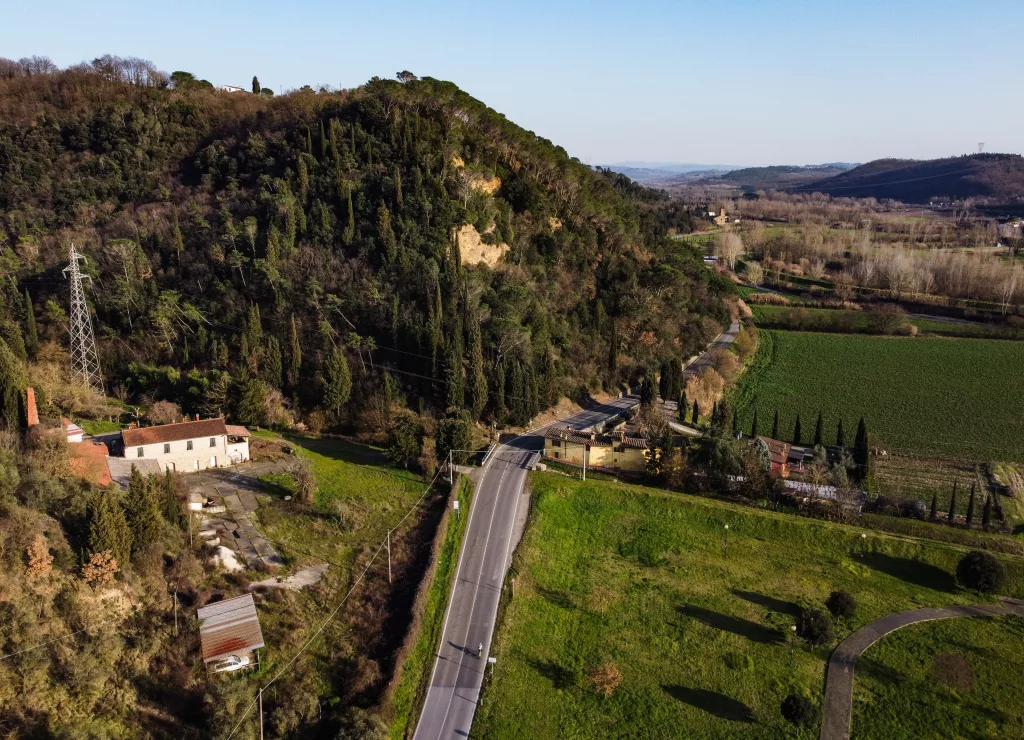
One of the most fascinating wooded areas in Montelupo Fiorentino is the Camaioni Woods, which extends for over 8 hectares and was opened to the public on April 18th, 2015.
One of the most fascinating wooded areas in Montelupo Fiorentino is the Camaioni Woods, which extends for over 8 hectares. Opened to the public on April 18th, 2015, after being cleaned and restored, the Camaioni Woods now feature a trail of about 3.5 km that mostly runs on municipal land, but also includes some private property sections.
Ideal for family trekking, the trail boasts various points of interest along the way: the Astronomical Observatory (an ideal starting point, thanks to its convenient parking), the small church of San Michele a Luciano (whose existence was first reported in 1243), as well as traces of ancient ruins of the Luciano castle. The ascent is about 220 m, not suitable for strollers.
The route is circular and its estimated walking time is about 2 and a half hours, but you can access it from different points and choose to walk only through a short section.
Where History meets Nature
The Camaioni Woods are a testament to an ancient woodland. The predominant presence of pine trees is due to the many centuries of wood exploitation to fuel the kilns in Montelupo, Samminiatello and Camaioni, which drastically reduced the presence of oak and holm oak.
The church of San Michele a Luciano deserves a brief mention, a precious hidden gem: an ancient building on the so-called St. Michael’s line, which starts from the Skellig Michael sanctuary in Ireland and reaches the Mount Carmel monastery in Israel. Along the way, people can find countless important religious buildings dedicated to the Archangel, such as the evocative Mont-Saint-Michel in France and the Sacra di San Michele in Turin.
It is a small Romanesque church from the 13th century, whose semicircular apse is covered with frescoes depicting the Last Judgment, the work of an unknown artist from the early 15th century.
The face of Christ in the painting shows significant similarities with the Holy Face of Manoppello and it’s considered of great historiographic importance, due to its connections to the lost Church of Santa Croce in Gerusalemme in Rome.
Trail length: 3.16 km
Total ascent: +144 m – 144m
Estimated walking time: about 2h
Difficulty: easy
The local plant life
In the Camaioni Woods you will mostly find oaks (Genus Quercus): these trees are resistant to arid and shallow soil where carbonate rocks such as downy oak and Turkey oak are also present. Other more valuable species, the sessile oak and pedunculate oak, have been reduced to remnants by human action. There are also hornbeams and ash trees. Over the years, the woods have undergone many changes due to human action and they are currently managed as coppice, with cuts every 10 years or so.
Downy Oak (Quercus pubescens): it is the most widespread oak species in Italy, to the point that in many places it is simply called oak. It belongs to the Fagaceae family. It’s highly resistant to drought and it can also adapt to relatively cold climates. The main diagnostic process to identify such species is by feeling its leaves or buds: they are covered with a fine hair that can be easily appreciated. The rusticity and plasticity of this plant, along with the great vitality of the stump, have allowed the Downy Oak to withstand destructive human interventions through the centuries. Fun fact: it is easily recognizable in winter due to the dry leaves that you can still see on its branches, unlike other oak species.
Manna Ash (Fraxinus Ornus): this species is very common throughout the entire peninsula, from the pre-Alpine belt of the Karst, to the Lombard lakes; it has spread from countless valleys to the mountain slopes in the heart of the Alps, at different altitudes: up to about 1000 m in the North and about 1500 m in the South. A rather thermophilic and xerophilous species, it prefers slopes over shady and cool valleys and it’s formidably capable of recolonizing forest areas where a fire or previous old reforestation has occurred, due to its high rusticity and seed production. It has an erect trunk with smooth, grayish, opaque bark and its wide crown is formed by opposite deciduous leaves, whose upper side is of a beautiful green color, while its lower side is lighter and hairy along the veins.
Fun fact: in Sicily, some plants were cultivated for manna production!
Ferns: Walking through the Camaioni Woods, especially in areas characterized by high humidity throughout the seasons, you will encounter various species of ferns and a species belonging to the Lycophytes family (Selaginella denticulata), not to mention a multitude of mosses and liverworts. Ferns and selaginella do not produce flowers, but have sporophylls, leaves that produce sporangia, which are the organs responsible for reproduction. Reproduction is not seed-based, but spore-based. During the early stages of the plant colonization of the mainland, one of the fundamental events was the development of spores with durable protective walls, capable of tolerating arid conditions; however, ferns still require water to complete reproduction. Often contained in yellow or brown structures, said spores can be easily mistaken by less experienced observers for insect eggs and thus considered harmful. Generally, the period in which the spore-bearing structures in ferns can be observed is from May to August, but it obviously changes depending on the species.